If you want a fast, reliable place to experiment with cutting-edge image models today, start with phenomenon that has the creator community buzzing—Google Nano Banana—the quietly explosive model redefining what prompt-based visual editing can do.
The Quiet Arrival of a Powerhouse
Unlike splashy launches with countdowns and paid teasers, the Nano Banana model slipped into the spotlight through blind tests on image-editing arenas. No celebrity demo. No press kit. Just results that kept winning head-to-head comparisons.
Early testers noticed something unusual: when asked to replace a character, keep the background intact, preserve lighting, and maintain facial identity, this newcomer didn’t falter. It handled multi-step edits that usually trip up even strong systems. That earned it a nickname—Nano Banana Google—because its performance felt “big-lab.” But to date, there’s no official confirmation of origin. Mystery intact. Hype justified.
What Makes Nano Banana AI Different
Here’s why creators—from indie designers to brand teams—are watching closely.
1) Prompt Precision That Feels “Human-Aware”
Describe a scene like you would to a collaborator—“swap the jacket to a satin bomber, keep the street reflections, make dusk feel warmer, and don’t touch the hair.” The Nano Banana image result tends to understand nuance and apply edits while preserving composition. That blend—semantic understanding plus visual restraint—is rare.
2) One-Pass Editing (Fewer Masks, Fewer Do-Overs)
Traditional pipelines often need manual masks, iterative re-renders, and cleanup. With Google Nano Banana, complex edits more often land in a single pass. That means faster ideation cycles, better momentum, and fewer artifacts creeping in as you iterate.
3) Scene Integrity and Character Consistency
Nothing breaks immersion like a subject’s face “drifting” between edits. The Nano Banana model is notably strong at locking identity while modifying clothing, pose, or context—and keeping lighting believable. For product, fashion, and character work, that’s gold.
4) Speed for Real Workflows
Creators move fast. Teams ship daily. Nano Banana AI is repeatedly praised for being snappy—turning prompts into usable visual output in seconds, not minutes. Speed alone doesn’t win; speed with fidelity does.
5) Style Range Without the Whiplash
Photorealism, editorial, stylized portraits, anime, cinematic frames—Nano Banana image translations show range without losing coherence. That makes it a versatile option across marketing, content, and entertainment pipelines.
What We Still Don’t Know (And Why It Matters)
Let’s keep it real. Despite the nickname Nano Banana Google, the developer is unconfirmed. There’s no official API, no whitepaper, and no press tour. And like any frontier model, imperfections persist:
- Hands & micro-anatomy can still glitch under difficult angles.
- Text rendering in-frame remains hit-or-miss.
- High-specular lighting scenes sometimes show odd reflections.
The mystery doesn’t diminish its usefulness—but it does mean teams should treat it like a fast-moving target. Today’s strengths can sharpen. Today’s gaps can close. Keeping your workflow flexible (and platform-agnostic) is the smart play.
How the Community Reads the Signal
Across forums and pro chats, a pattern emerges:
- Editors love the one-pass competence—less mask wrangling, more creating.
- Art directors appreciate the lighting and composition restraint—edits feel “native” to the shot.
- Indie creators are excited by speed and identity consistency, especially for character-driven posts and shorts.
The consensus? Google Nano Banana isn’t just another model; it’s a workflow unlock. The kind that turns “we should try this” into “we already shipped it.”
Why Start on AIFacefy’s Flux AI (Even Before Public Access)
You asked for a practical path. Here it is:
- Centralize your experiments on a stable hub. AIFacefy’s Flux AI suite gives you a single place to test, compare, and standardize assets.
- Benchmark now. Learn how your prompts translate across engines so you’re ready to slot in Nano Banana AI the moment wider access appears.
- Ship with confidence. Flux’s tools are already designed for fast iteration and real-world outputs, so you’re not waiting on a mystery model to keep building.
When the industry is shifting under your feet, a reliable staging ground is a strategic advantage. Start here: Flux AI Image Generator.
Concrete Use Cases (Where It Already Shines)
E-Commerce & Product Content
Swap backgrounds to match seasonal campaigns, align lighting across a catalog, tweak materials (linen → satin), and preserve product identity. The Nano Banana model is particularly good at respecting object geometry while transforming context.
Fashion & Portrait
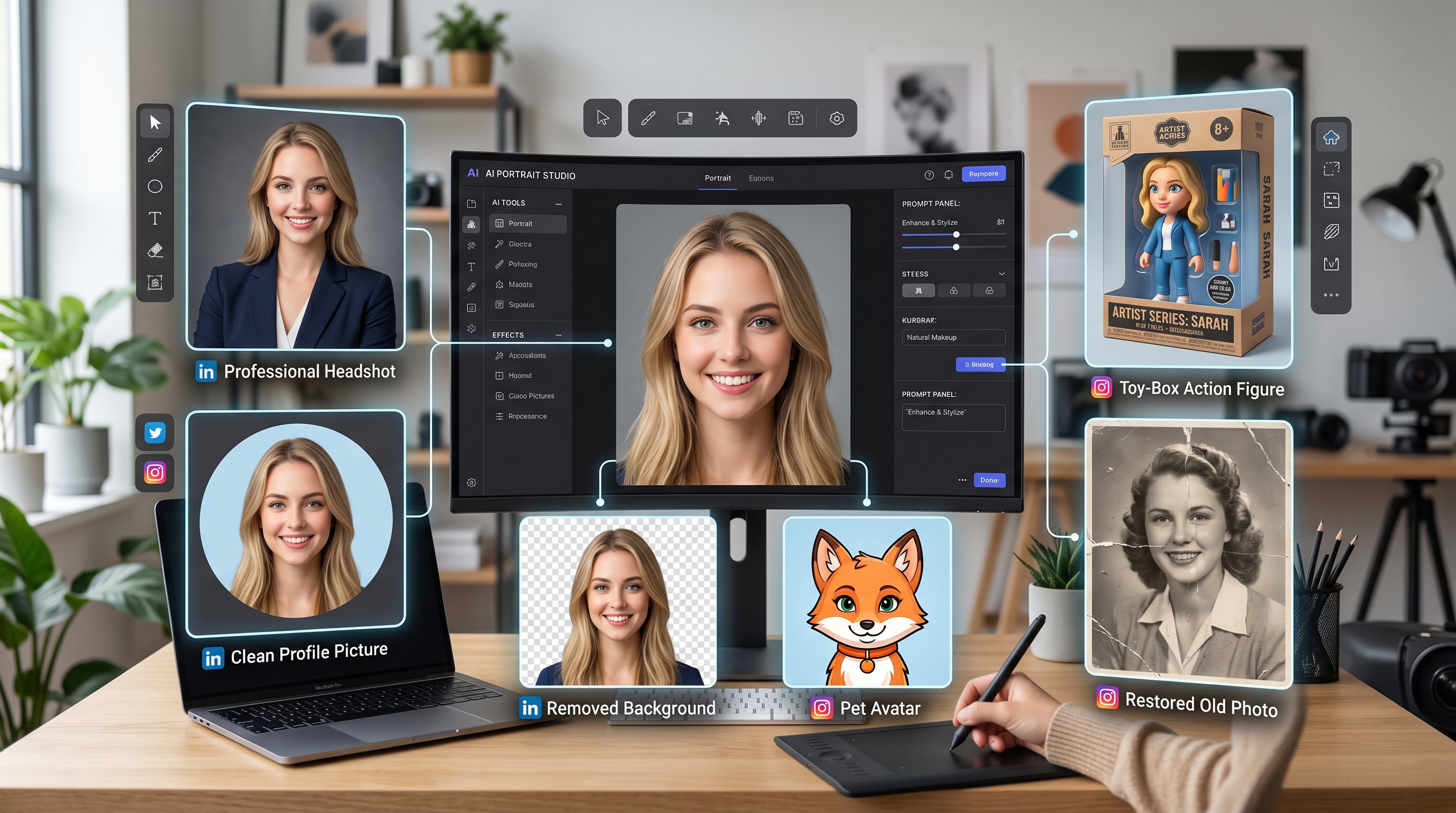
Change garments, adjust makeup tones, or add gentle style cues without creating a “different person.” With Nano Banana image, identity lock reduces retouching time.
Social & Short-Form Video Stills
Turn loose prompts into scroll-stopping frames fast. Cohesive visuals mean posts look like a series, not a grab bag.
Games, Film, & Previs
Concept characters, lighting studies, and location mood frames often benefit from prompt-rich edits. Google Nano Banana helps teams iterate faster toward a shared visual language.
Branding & Advertising
Rigorous brand systems need consistency. That’s where Nano Banana AI helps: precise edits that don’t blow up your grids, tone, or typography in one bad render.
Side-By-Side: Where It Stands in Today’s Toolset
There’s no single “best model” for everything—there’s the right model for this task right now. Compared with popular generators and editors:
- Semantic, multi-step edits: The Nano Banana model is unusually strong.
- Identity persistence: Better than many generalists, especially across sequences of edits.
- Lighting/scene preservation: Consistently convincing for product and portrait scenarios.
- Speed: Among the fastest for usable results, not just first drafts.
The takeaway: [Nano Banana image]https://aifacefy.com/nano-banana-ai/) feels like a specialist—exceptional where it focuses, complementary to broader toolchains.
Getting Ready: A Practical Adoption Plan
You don’t need to wait for an API announcement to benefit. Here’s a simple, production-minded plan you can implement now:
-
Standardize Prompts
Create a small library of “house prompts” for product, portrait, and scene work. Log what each engine returns. Update quarterly. -
Define Quality Gates
For each asset class (e.g., PDP images, campaign hero frames), specify pass/fail criteria: identity match, lighting continuity, hand/fabric fidelity, edge cleanliness. -
Use AIFacefy’s Flux AI as Your Sandbox
Centralize experiments and output comparisons in one place: Flux AI Image Generator. Keep results reproducible. -
Tag & Track
Tag renders by prompt + engine + revision. When Google Nano Banana becomes broadly accessible, you’ll know exactly where it fits. -
Pilot With Real Deliverables
Pick low-risk deliverables (IG carousels, blog headers) to test time saved and revision reduction. Roll wins into bigger campaigns.
Common Pitfalls (And How to Avoid Them)
- Over-editing in one prompt: Even strong models can “mush” realism if you cram too much change at once. Break complex requests into logical steps.
- Ignoring lighting logic: Ask for specific lighting behavior (e.g., “retain rim light on left, keep window reflections”). The AI image generator responds better to asserted constraints.
- No identity references: For characters, include a short identity anchor (“keep nose bridge and eye spacing; preserve hairline”). This helps Nano Banana AI maintain likeness under heavy edits.
- Forgetting brand rules: Lock brand hexes, contrast ratios, and safe areas before you prompt. Guardrails in, magic out.
What’s Next for Nano Banana Google?
Speculation ranges from “stealth Imagen derivative” to “entirely new stack.” Possible futures:
- Public Beta or API with throttled access for teams doing commercial work.
- Creative-suite integrations, making edits accessible in familiar UIs.
- Model families tuned for portrait, product, and cinematic scenes.
Whatever the roadmap, the signals are clear: this class of semantic editing is here to stay, and it’s about to influence how studios, agencies, and solo creators plan their pipelines.
Quick FAQ
Is it really by Google?
No official confirmation. The nickname Nano Banana Google reflects community speculation tied to its performance.
Can I use it commercially today?
Access is limited and may vary by venue. Build your workflow now on Flux AI Image Generator so you can drop it in when access opens.
Does it fix hands and text perfectly?
Not perfectly. It’s better than average, especially at identity and lighting, but micro-anatomy and text still need manual checks.
Will it replace other tools?
Unlikely. It looks like a specialist—fantastic at multi-step semantic edits and scene integrity—best used alongside your broader toolset.
Final Thoughts: Start Smart, Scale Fast
The creative industry doesn’t wait for perfect. It ships with repeatable. That’s why your smartest move today is to anchor your experimentation on a dependable hub and be ready to incorporate breakthroughs like Google Nano Banana the moment they stabilize.
Begin where you can build today—and scale tomorrow. Explore Flux AI Image Generator on AIFacefy: get started with Nano Banana now.